What Are Full Frame Sensors

In digital cameras, full frame sensors are sensors that measure 36mm x 24mm.

The size is based on 35mm film cameras. But how?

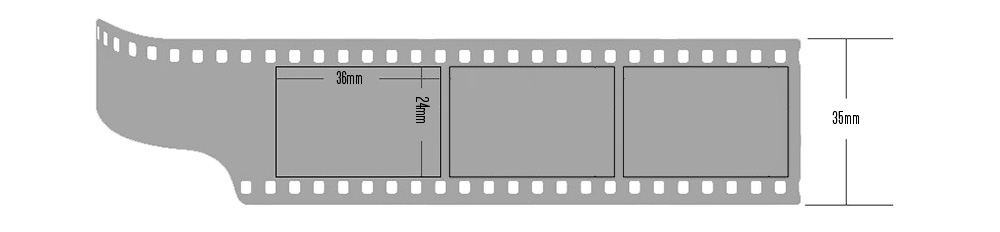
I hope this diagram makes it clear. The top to bottom height of 35mm film is 35mm. That’s the standard, and it has been the standard for over a century.

But the film has to move along so that with each wind-on of the film advance, a new frame is in front of the lens ready to be exposed.

The manufacturers stamp sprocket holes at regular intervals along the film. The film advance sprockets catch in those holes and move the film along.

If the image that the lens casts onto the film covered all the 35mm depth of the film, then the finished photographs that we look at would have holes at regular intervals across them, corresponding to the sprocket holes.

So the camera manufacturers put a frame in front of the film to mask off any light that might fall beyond the rectangle. And the size of the frame is a rectangle that’s 36mm x 24mm.

And that’s why ‘full frame’ digital sensors are 36mm x 24mm

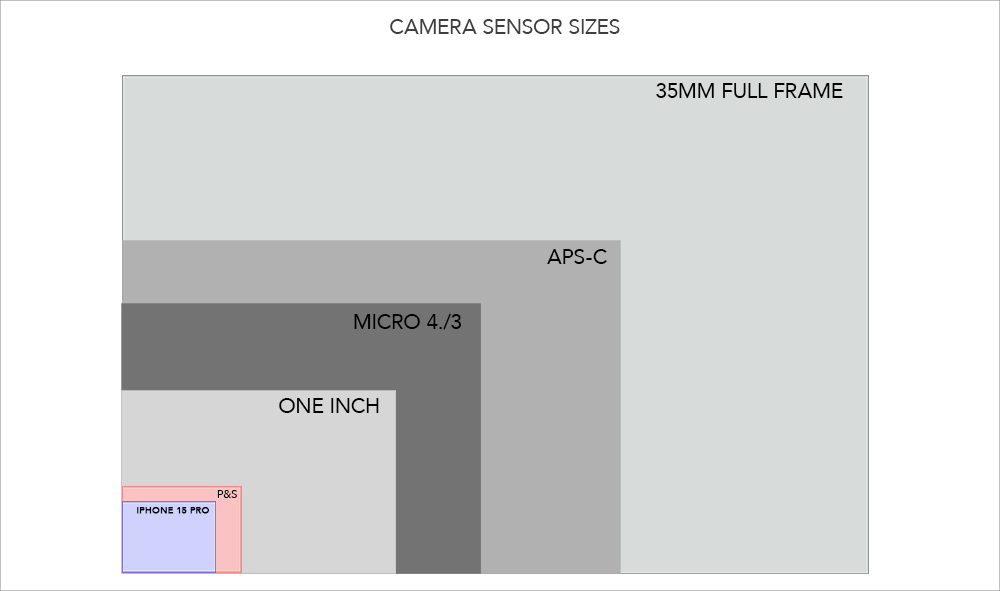
Not all digital sensors are full frame. Here are the relative sizes of some of them, from full frame down to the sensor found in the iPhone 15 Pro. There are bigger sensors than full frame but they are pretty uncommon.

Why I Chose The Canon EOS R6

After looking at thousands of photographs, I have developed a capacity to see a photo and know something about the camera that took the photo.

I am not claiming some special capability – rather it is open to anyone who spends enough time looking at photographs.

After testing full frame cameras from Canon, Nikon, and Panasonic and comparing them with APS-C cameras I have had, I concluded that full frame really is better than APS-C for clean images with lots of detail.

The only manufacturer that currently has heavier full frame models and lighter weight full frame models is Canon..

The R6 II is out of my budget but the R6 gets positive, even glowing reviews from everyone and it is tumbling in price. The only question mark hanging over it is that it is ‘only’ 20MP.

And Canon also has the lighter weight R8.

There is only one reason to get the Canon R8 over the Canon R6 and that is that it is lighter. It weighs 460g compared to the R6’s 680g – a difference of 220g.

The little Ricoh GR III weighs 257g, so how significant can that extra 220g be?

After picking up both and handling the two cameras for a while I can say that the added weight is noticeable. After handling the R8 for a while, the R6 feels heavy.

So what are the reasons to get the Canon R6 over the Canon R8

  • Bigger battery
  • Two SD UHS-II memory Card slots
  • A joystick to move autofocus points
  • In-body image stabilisation of up to 8 stops
  • 0.5-inch OLED colour EVF 3.69 Million dots 1280 × 960 pixels
  • Balances with longer lenses.

Reasons not to get the Canon R6 over the Canon R8

  • 220g heavier

Reasons not to get the Canon R8 over the Canon R6

  • Smaller battery
  • One card slot
  • No autofocus joystick to move autofocus points
  • No in-body image stabilisation
  • 0.39 inch OLED colour EVF 2.36 Million dots 1024 x 768 pixels

After hesitating for a while and testing other cameras I decided on an R6. If it feels too heavy and I can’t get used to it as an ‘all day carry around’ camera, then I can get an R8 as a travel camera – not ideal because of the lack of a second card slot, but doable. And because the two cameras are from the same manufacturer I can transfer the handling (where the buttons are, etc) to the other camera.

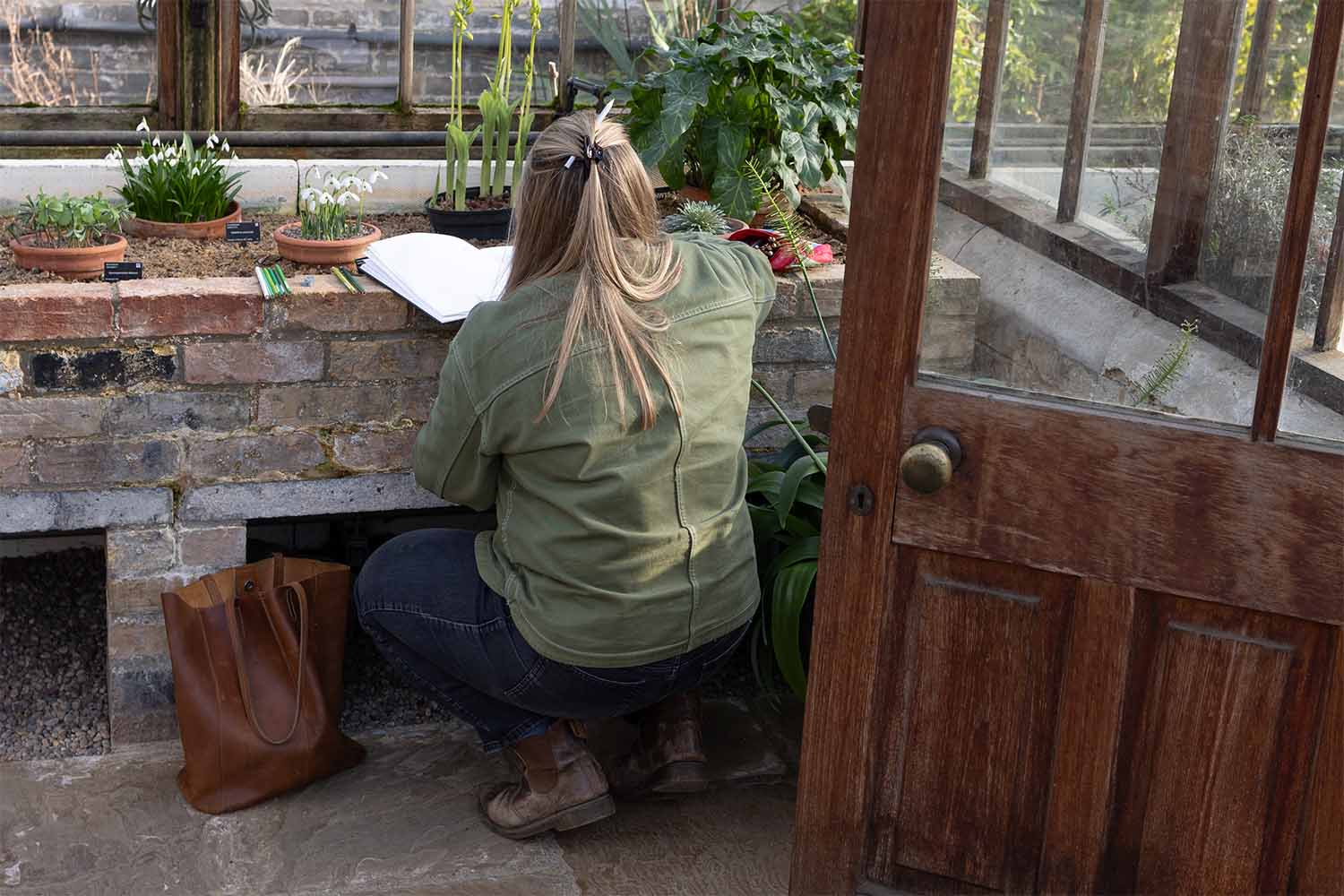
Here are a couple of shots I took today in the Botanic Garden in Cambridge with the R6 and the 35mm f1.8 STM lens. The second one is a 3:2 crop of the portrait orientation shot that I took, so it is 45% of the full frame.

The Majority Of EVFs Come In One Of Two Specifications

Let’s start with cameras with optical viewfinders. The photographer see the actual scene the camera is pointed at because the light enters the lens and up to the viewfinder and into eye of the photographer.

The vast majority of cameras with optical viewfinders that look right out through the lens are Single Lens Reflex (SLR) cameras.

SLRs are called ‘reflex’ cameras because:

a) light enters the lens

b) a prism and a mirror send the light up into the viewfinder, and

c) the mirror has to flip up out of the way for a fraction of a second when you take a shot to let light onto the sensor. And then the mirror flips back again.

One way to think of what looking through the viewfinder of an SLR means is to imagine you are looking through a periscope in a submarine. It’s just that the periscope is only a half an inch tall and upside down – with your eye at the viewfinder, which is higher than the lens.

Mirrorless cameras do away with the prism housing, the mirror box, and the mechanism that flips the mirror up and then down again.

With no prism and no mirror, there is nothing to slap up into the housing and bump back down again. So mirrorless cameras are quieter, with less vibration.

With mirrorless cameras the light enters the lens and a tiny digital representation of the scene is shown in the Electronic Viewfinder (EVF).

One of the advantages of an EVF is that you see exactly how the shot is going to come out. If the picture is too dark, change the shutter speed or the aperture and brighten the image in the EVF – and the photo you get when you take the shot will be just as it looked in the EVF.

Some people don’t like electronic viewfinders because they are yet one more barrier between you and the scene.

You win some you lose some.

Not All EVFs Are The Same

In my search for my next camera, I have been weighing up EVFs and comparing them across different brands and different sensor sizes.

Here’s the thing – I have discovered though is that there is a great similarity in EVF specifications across different camera brands.

Generally speaking the EVFs in smaller sensor cameras are smaller than the EVFs in bigger sensor cameras.

But, also – more expensive cameras in a range of models have bigger EVFs.

More specifically, the majority of EVFs come in two sizes, shown by the relationship between these two rectangles. The red edged rectangle represents the size of a typical viewfinder on an APS-C sensor or a low end full frame camera.

The black edged rectangle represents the size of the viewfinder typically found on a full frame sensor or a high end camera with an APS-C sensor..

Look at the EVF specifications on different brands and you will see that all of them more or less fall into one of two specifications.

EVF Specifications

Nikon Z6II (full frame sensor)
1.27-cm/0.5-in. approx. 3690k-dot (Quad VGA) OLED electronic viewfinder with color balance and auto and 11-level manual brightness controls

Canon R6 (full frame sensor)
1.27-cm/0.5-in OLED color EVF, 3.69 Million dots

Fujifilm X-T5 (APS-C frame sensor)
1.27-cm/0.5-in OLED Color Viewfinder, Approx. 3.69 million dots
The Fuji X-T5 is a top of the line APS-C camera – so it has a bigger EVF

Nikon Z50 (APS-C frame sensor)
0.99-cm/0.39-in. approx. 2360k-dot (XGA) OLED electronic viewfinder with color balance and auto and 7-level manual brightness controls

Fujifilm X-S20 (APS-C frame sensor)
0.99-cm/0.39-in with 2.36 million dots of resolution and a 0.62x magnification,

Canon R8 (full frame sensor)
0.99-cm/0.39-in) OLED color EVF, 2.36 Million dots
The Canon R8 is a low end full frame camera, so it has a small EVF.

Other Factors

One thing I haven’t talked about is the refresh rate of the EVF. Because the scene is a digital representation, it has to refresh as the camera moves or things in the scene move. Of course optical viewfinders do the same, but at the speed of light so we don’t detect any lag.

That is not so with EVFs. Poorer quality EVFs can’t keep up as the scene changes. They are described as laggy – meaning that the EVF is playing catch-up all the time as the scene changes.

Another factor that applies to EVFs and OVFs is the layout of the viewfinder. Some have information (shutter speed, aperture, ISO and other info) in the EVF. Some have the info at the top and bottom of the EVF. I find that a pain (that’s the Nikon Zf). Some have super clear letters and numbers at the bottom of the EVF (Canon R6 for example)

Catherine Jones, Bridge Street, Cambridge

Of course, it is the opportunity to photograph someone absorbed in what he is doing that gives me the desire to photograph. But the colours – the green of the gate, the blue of the jeans, the blue-green of the shop, and even the top and jeans of the woman walking towards me – helped bring it together. The name-board above the shop and the top and bottom bards of the gate lead away to the left, out of the shot. The man is leaning into that and that helps put dynamism into the shot because the sloping angles are set against the square verticals and horizontals.

Ricoh GR III at 400 ISO at f/ 2.8 and 1/125 second.

Storing Unexposed Film

Neither of the two photos here were shot on film. Digital images outstripped film years ago. So what’s the attraction of film?

Someone once said that the technology with digital cameras is in the sensor and the processor, whereas the technology with film is in the film itself. And each kind of film has its own characteristic. It’s interesting enough that I shoot film occasionally.

'Put It To The People' anti-Brexit march, 2019
‘Put It To The People’ anti-Brexit march, 2019

Five rolls of film arrived in the mail from Analogue Wonderland film lab this morning, which prompted me to write this. So here goes with the tips.

Keep unexposed film in the canister and keep it cool and dry. Humidity is a bigger problem is some locations than others, obviously. Film may need minimal protection in a well ventilated house in the United Kingdom but a lot more protection in a humid climate, so read the following accordingly.

Keeping film cool doesn’t have to mean keeping it in a freezer of refrigerator. It will help, but only if you can be sure the containers are airtight. Otherwise the film won’t keep dry, and it’s as important to keep film dry as it is to keep it cool.

Cool means 10-20°C (50-70°F) and keep the film as near a constant temperature as possible because temperature variations degrade film because of expansion and contraction.

Store canisters upright to minimise contact between the layers on the roll. In other words don’t store on their side or the layers will be resting on one another under their own weight and can stick together or chemical can migrate through contact.

Put a desiccant bag with the film canisters to absorb any moisture. Desiccant bags come packaged with lots of products we get in the post and they can be dried out under gentle heat and reused over and over. Remember the chemical in the desiccant bag is poisonous so dry over a heater and not in an oven or microwave.

Keep film away from magnetic fields – not usually a problem in a house, but it is a problem going through airport security. The problem is worse when going more than once through airport security and it is worse with a high ISO film such as 3200 ISO. So maybe plan ahead to buy film at your destination to minimise the number of times the film passes through the scanner. You can ask airport security to examine by hand, but they may not agree.

Storing Exposed Undeveloped Film

If you are not going to develop your film right away, then all the tips here apply to exposed film also.

Some photographers amass a lot of undeveloped film. Gary Winogrand would keep his exposed rolls for a couple of years sometimes before he developed them. That wasn’t because he was lazy. it was because he wanted to remove himself from the scene he exposed. He wanted to see the photo as though he was looking are someone else’s photographs.

Anyone who photographs knows what this means, that we see things in our own photographs and give them qualities that aren’t there. At least, qualities that a disinterested eye doesn’t see.

I recall watching the photographer Martin Parr judging a contest week by week, until there was a winner. The subject for that week was street photography. Parr looked at a photo from one contestant and said ‘But it is not a photograph’.

I forget exactly what the photograph was, but something like a person walking along a street.

The question is, is there is a story in there – an expression, a stance, something that says there is a recognition of the human condition in there?

It’s other people that show us who we are, and for photographers that make humans interesting.

If that is not there in a photo – particularly in street photography – then as Parr says, it is not a photograph. What it is, is just a random snap the photographer could have taken with his or her eyes shut.

The reason I am mentioning all this is that at his death Winogrand’s refrigerator contained more than 2,500 exposed but undeveloped rolls he’d shot. There was a big hoo-ha after his death about whether his later films were any good but the Metropolitan Museum of Art in New York. thought so. They had a retrospective of Winogrand’s work including from some of the 2,500 rolls of film Winogrand never developed.

'Put It To The People' anti-Brexit march, 2019
‘Put It To The People’ anti-Brexit march, 2019