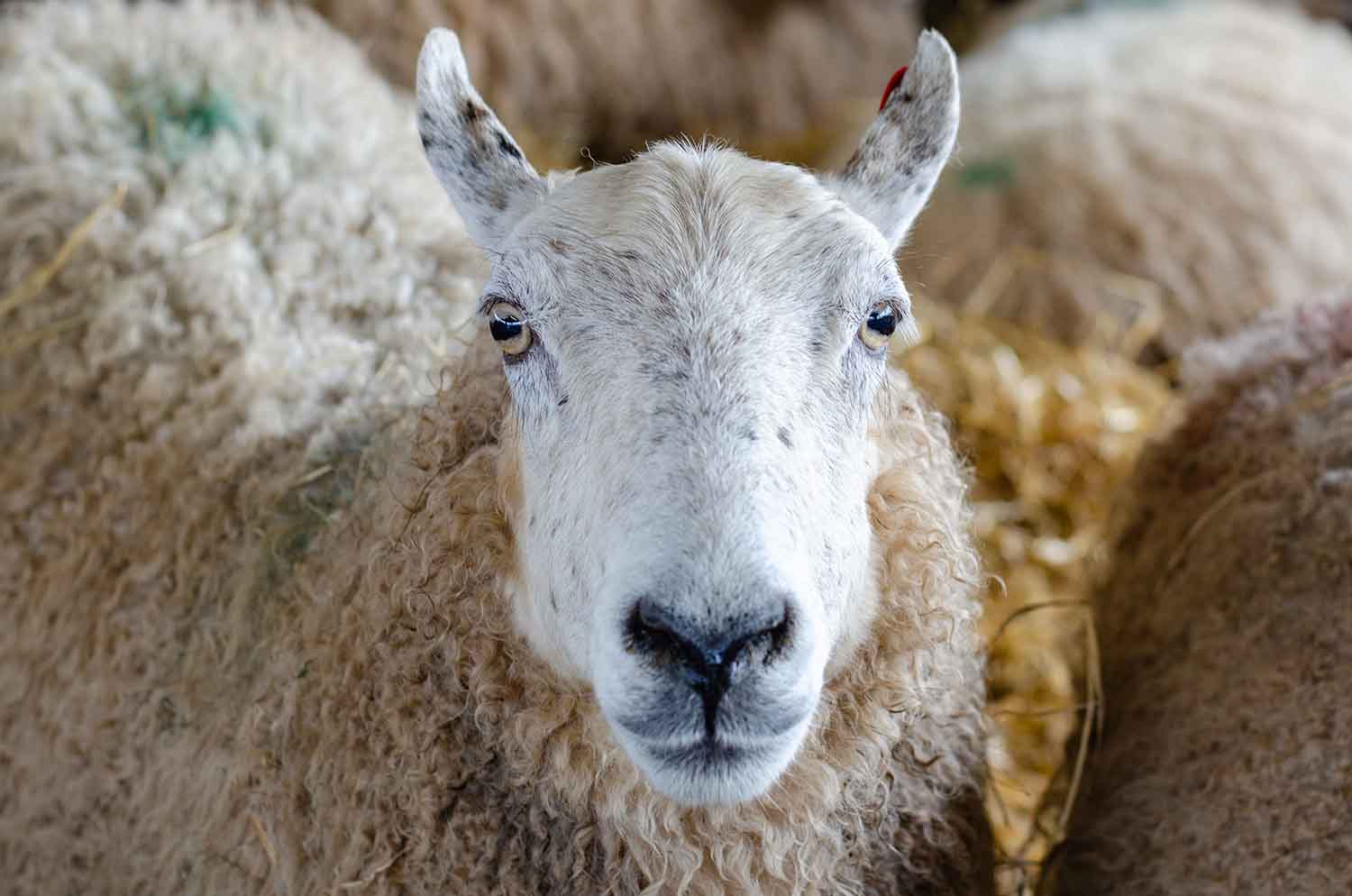
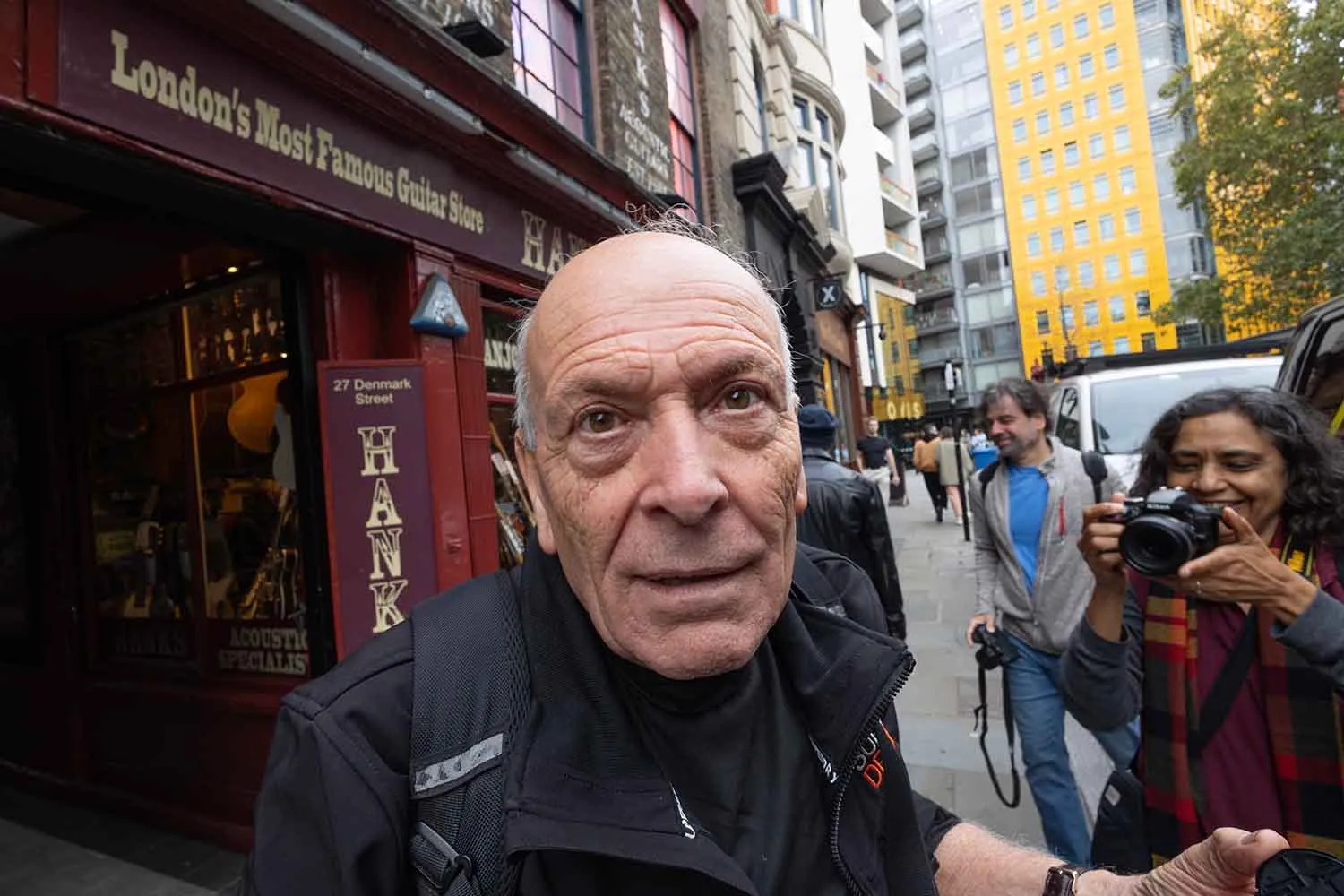
If you stand close to someone, just inches away, their face will be distorted. The eye and brain working together can do a wonderful job of de-distorting the image but if you look carefully you can see that the sides of the face are narrower and the fall away is pronounced. As you move back a bit, still looking, you see the face widen a little and the nose become less prominent.
A camera is the same. If you plonk it close to the subject it will distort it.
The closer it is to the subject the more it will pull the nearest part of the subject forward and the more it will push the sides away. And conversely, the further you are away from the subject the more that different parts of the scene will compress from front to back.
You know how it is when you see cars in the distance coming towards you. They appear very close to one another. As they come closer, you see that the distance between them is greater than you thought.
Which is correct?
That’s more of a philosophical question, but for a photographer who want to work with this effect, he or she needs to know that standing further back compresses the scene from front to back. Even a face that is just a few inches from front to back will appear more flattened and wider when it is further away compared to when it is closes.
It is not the focal length of the lens. It is how far the camera is from the subject. If I use a short focal length lens and stand far back, the image will only fill a small part of the frame. If I am photographing a person, their face and body will not be distorted from what my eye would see.
If I move forward to fill the frame with a short focal length lens then the elements in the scene from front to back will separate more and give more space between them, and a face close up will be distorted, with nose protruding and face narrow as it seems to sweep away into the background/
The bottom line is that if I want to photograph a person and not distort the face, and I want to fill the frame, then I need a long focal length lens. That is why we have long focal length lenses.
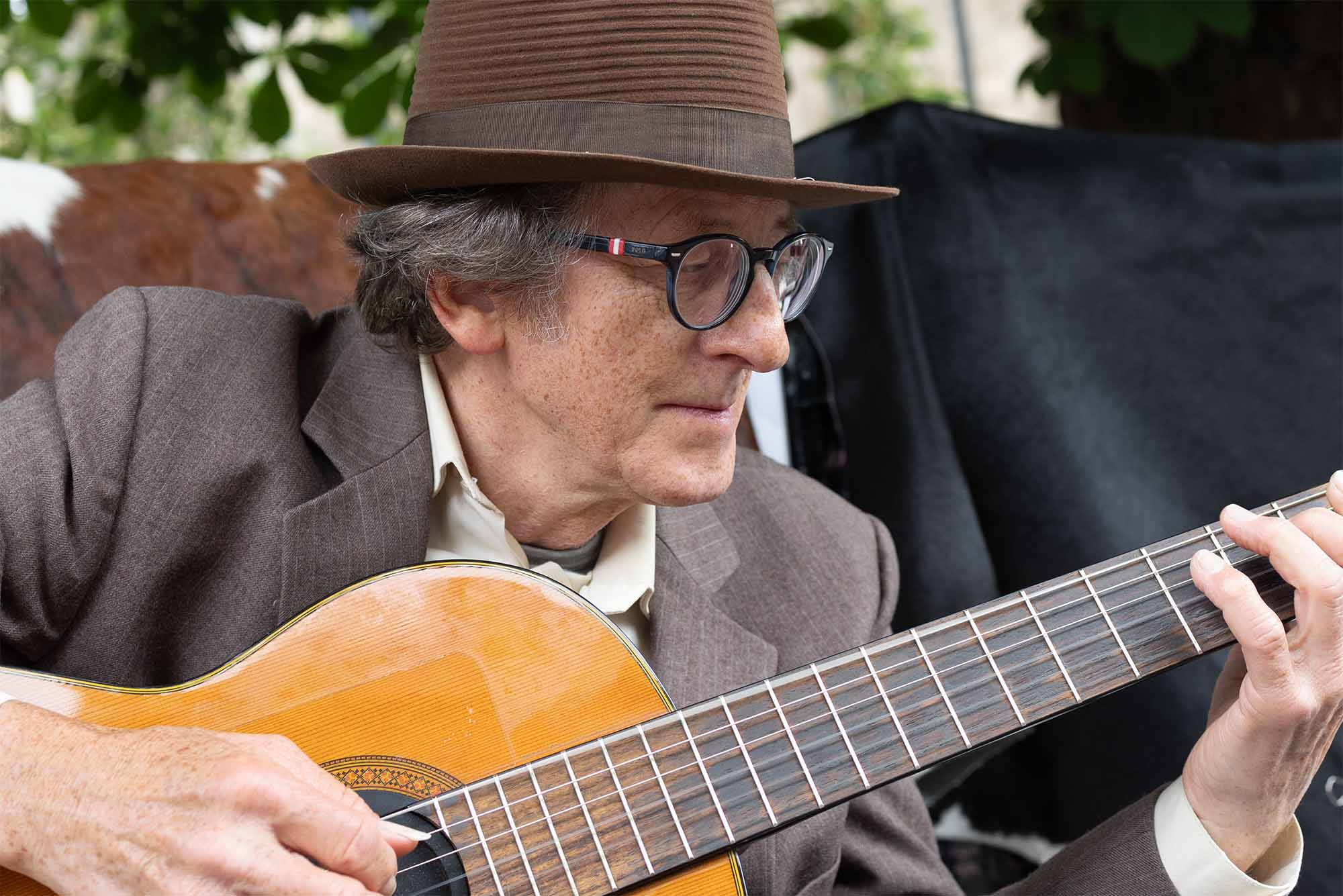
So this photo, of a guitarist outside the Tate Modern in London, was not taken with a dSLR.
I took it with a Canon R6 with the Canon 35mm f1.8 lens. The R6 is a mirrorless camera, and both the body and the lens are image stabilised.
Could I have shot it with a full-frame dSLR? For sure, but none of the major manufacturers make dSLRs any more. Of course, there are plenty of used dSLRs around, but they won’t be around for ever.
So, was the death of the dSLR a mistake? Is it even a question? Are there any substantial advantages to either system? Let’s take a look.
A full battery on a dSLR goes on forever. More than a thousand shots per charge is commonplace. With mirrorless cameras you have to think about how long the battery is going to last. So batteries are a kind of an issue, because DSLRs just go on and on and no one likes to lose a benefit that they used to have. But it is not a big deal to carry an extra battery, and keep the one in the camera topped up.
Bigger grips aren’t really an issue. It depends on the camera. The grip on a Canon R6 is every bit as pleasant to hold as that on a Nikon D750.
And although mirrorless cameras can shoot at astronomically high frames per second, who actually needs that? I mean, pro sports photographers do, but most photographers don’t.
What about an optical viewfinder (OVF) versus an electronic viewfinder (EVF)?
I sold my crop=sensor Nikon D500 dSLR and switched to Canon mirrorless. Then about a year ago I bought a Nikon D750 dSLR because I missed looking through an OVF and I had not owned a full-frame dSLR since I had a Nikon D700 years ago..
I used the D750 for a while and then sold it. I learned from that experience that choosing between the two wasn’t because of the OVF versus EVF question.
An OVF is as near to looking directly at an object as you can get. Light enters the camera through the lens, and is reflected by mirrors and a prism up and into the viewfinder.
The hump on the top of a dSLR is what houses the mirror box. It operates like a tiny periscope, and its job is to direct light that comes in through the lens into the viewfinder, using a mirror and a prism.
The technical problem with a dSLR is that that when you press the shutter to take a photo, the mirror has to get out of the way. In its rest position the mirror is in the path of the light that needs to reach the sensor. So the mirror housing springs up and then down again. That’s the ‘reflex’ in single lens reflex.
Not only that but the prism housing has to do it without shaking the camera. So it has to be damped, which adds more complexity to the mechanism.
If you shoot at 1/4000th of a second it has to move up and down in 1/4000th of second. That’s a lot to ask of a mechanical device.
When you think that some cameras can shoot at shutter speeds of 1/8000th of a second, it’s amazing that a mechanical device can do it at all.
Mirrorless cameras don’t have a prism and mirror arrangement. Instead you are looking at a digital representation of the scene in the viewfinder.
The improvements since EVFs first appeared are lower latency and more dots. Lower latency means that as you move the camera around or the scene changes, the electronic viewfinder refreshes and keeps up with the changes smoothly. More dots means that scene is clearer, brighter, and more detailed.
So that’s an advantage to mirrorless cameras. But some people just don’t like looking at an eyepiece that is basically a tiny TV, and prefer looking as directly as possible at the subject. That’s what led me to try the D750. But in the end I realised that the view in a good EVF is just as good.
Some mirrorless cameras don’t have an EVF at all. Instead, you compose in the screen on the back of the camera. And even when there is an EVF, some photographers still prefer to compose on the screen at the back of the camera.
Bottom line is that switching or not switching from a dSLR to mirrorless is not an OVF versus EVF question.
Autofocus
Mirrorless cameras and dSLRs autofocus differently. dSLRs cannot use the main sensor that records the image when a photo is taken because the mirror box is in the way.
So dSLRs use a separate sensor located at the bottom of the lens throat of the camera body and a small amount of the light from the mirror box is directed to this separate sensor and that initiates autofocus.
It works well enough but not as well as if the whole of the sensor was used, which is what happens with mirrorless cameras.
Consequently, we now have accurate real-time eye tracking autofocus that ‘sticks like glue’ to its subject. More than that, we have AI-powered focus and subject tracking.
This is all good, but most of the time I use central spot focus and if I am shooting people then subject detection. And for those times they yes, subject detection is something mirrorless does better.
Speed
The Nikon D500 dSLR was designed for speed and it could shoot at 10 frames per second.
Because there’s no mirror box to flip up and back, mirrorless cameras that can shoot at 15 frames per second with a mechanical shutter are common and some go much higher with electronic shutter.
This is not video output; these are individual photos taken at those high numbers of frames per second.
The incredible autofocus that can ‘stick’ on a moving subject, coupled with high frame rates means that photographers can now capture fast moving subjects with pin sharpness in a way that was impossible a few years ago.
Just think of the shots you see nowadays in newspapers and magazines of olympic gymnasts or footballers or basketball players caught in mid-air with pin sharpness.
In-Body Image Stabilisation
This is a big advantage of mirrorless cameras. In-body image stabilisation (IBIS) allows slow shutter speeds without camera shake. Image stabilisation in lenses has been around for years, but when you can stabilise the body as well as the lens, you get even more stabilisation. And it shows.
Plus, not all lenses are stabilised, so having a body that is image stabilised frees you up to a greater choice of lenses.
Of course a slow shutter speed doesn’t help if the subject is moving fast, but slower shutter speeds that avoid camera shake are a huge benefit for static or slow-moving subjects, like shooting portraits.
Pentax is the only dSLR manufacturer that makes bodies with image stabilisation. But any dSLR still has to get over the problem of adequately damping the mirror slap from the mirror and prism housing flipping out of the way and then back when a shot is taken.
No matter how well the mechanism is damped, it is still a tremor that simply cannot match the vibration-free shots taken with a mirrorless camera.
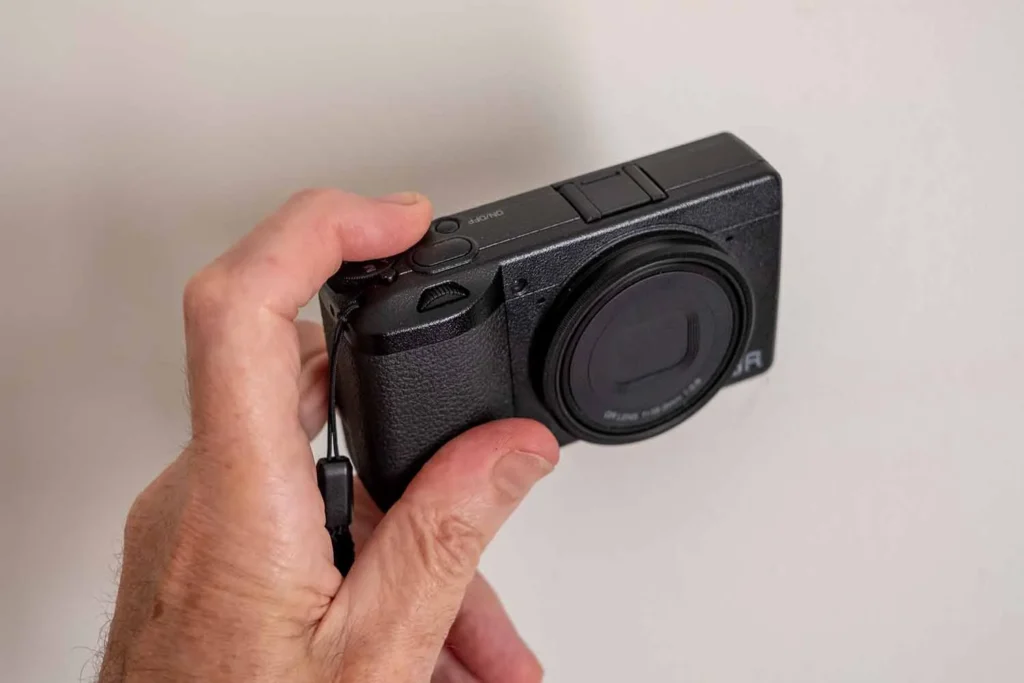
The Ricoh GRIII has IBIS, and I can shoot at 1/10th of a second and get sharp images. And it is tiny.
Weight
Mirrorless cameras weigh less than the equivalent dSLRs. It is true, but not by as big a margin as you might expect from removing the mirror box.
Twenty years ago I stopped taking my Nikon D700 around with me because it weighed 1095g. It was a great camera but not something I would casually put on my shoulder, My Canon R6 weighs 680g – a 415g difference, nearly a pound weight saved.
The Bottom Line
What do I want from a camera?
A big, clear, detailed EVF that I feel I can almost walk around in, with clear numbers in the display
To be able to see clearly and exactly where I am focusing
Good autofocus
A shutter button that is like the proverbial glass rod, that breaks cleanly
Rock-solid image stabilisation
Can I get all of those from a dSLR? Not so much. The one strength of a dSLR is the optical viewfinder. For example, my Canon R6 mirrorless camera it sometimes tells me in no uncertain terms that it is an EVF. It gets the exposure completely wrong for a moment when I move to a new subject. The EVF washes out and I have to stop half-pressing on the shutter, and recompose to get the EVF to correct itself.
That’s when the camera reminds me that I am looking at an EVF, and I don’t like the experience.
Apart from that, and for image stabilisation alone, mirrorless wins.
Noun: an informal photograph taken quickly, typically with a small handheld camera.
If I had to guess when someone coined the term ‘snapshot’ I would think it was definitely within the past forty or fifty years. And if I was told it was earlier, I would guess in the 1930s. And if I was told it was even earlier, I would guess it was when Kodak brought out the Box Brownie camera in about 1900. If I was told it was even earlier, I would guess it was when George Eastman brought out the first Kodak camera in 1888.
In fact the term ‘snapshot’ was coined by Sir John Herschel, a British scientist and astronomer, in 1860. Herschel used the term to describe a photograph ‘taken quickly, as a hunter would take a quick shot without aiming carefully’.
Stills is a photographic centre in Edinburgh. You can develop and print film there, attend courses on photography and design, and see what’s on in the gallery.
At the moment there is an exhibition of the life and work of the photographer Jo Spence, who was born in London 1934 and died in 1992.
She was merciless on herself and spent a lifetime examining her relationship with her mother and with the way society manages us. When she fell ill with breast cancer she documented what happened and how she was treated by the NHS.
She did phototherapy sessions with other photographers. One would act out a meaningful part of their life and the other would photograph it.
Jo did a series of herself as her mother, with all the aspects of that persona that Jo saw over the years. And she did a series of herself as a bride, and as a child, and as a woman investigating a hoover.
When she was 45 she started a degree course in Film and Photographic Arts at the Central London Polytechnic.
There she and Mary Ann Kennedy, Jane Munro, and Charlotte Pembrey formed a photography group known as the Polysnappers.
Amd their degree show was a series of panels on the subject of the politics of representation. You can see that in the image at the top of this article.
They combined commentary with bits cut out of newspapers and magazines, and the theme was clear: What is acceptable and desirable is pushed at us relentlessly. The task is to decode the message and know who is pushing it.
One panel caught my eye – and it is not directly on the theme of the politicisation of representation, but about photography and art.
There is a quote by Bill Jay that turns on its head some of the arguments about the second-class cinderella that is photography.
There is no doubt that art-photographers in America consider themselves a breed apart – one higher on the evolutionary scale of the medium – than photography in other fields. I remember discussing a set of documentary photographs with a critic and an historian who ended the conversation, to his satisfaction with the remark: ‘But of course they are not art’.
I agreed, which rather took him aback. ‘No’, I said, at their best such photographs are culturally, socially and historically more important than art…’ Why should anyone assume that Art is at the apex of a cultural pyramid and, by extension, anything that is not art is therefore less important?
…Photographers, then, have a cultural and social inferiority complex that is manifested in adolescent belligerency, an egomania that threatens to destroy the medium.
Oh Lord, won’t you buy me a Leica M9 ? I’m done shooting Nikons, I want to shoot prime. It’s full-frame or nothing, and a big LCD, And manual focus, please explain that to me.
Oh Lord, how I wanted a Leica M8, But now I am grateful that you made me wait. Worked hard all my lifetime, to get what is mine, Oh Lord, won’t you buy me a Leica M9.
Oh Lord, do this one thing, this one thing for me, And Lord I’ll review it – I’ll do it for free.