

So this photo, of a guitarist outside the Tate Modern in London, was not taken with a dSLR.
I took it with a Canon R6 with the Canon 35mm f1.8 lens. The R6 is a mirrorless camera, and both the body and the lens are image stabilised.
Could I have shot it with a full-frame dSLR? For sure, but none of the major manufacturers make dSLRs any more. Of course, there are plenty of used dSLRs around, but they won’t be around for ever.
So, was the death of the dSLR a mistake? Is it even a question? Are there any substantial advantages to either system? Let’s take a look.
A full battery on a dSLR goes on forever. More than a thousand shots per charge is commonplace. With mirrorless cameras you have to think about how long the battery is going to last. So batteries are a kind of an issue, because DSLRs just go on and on and no one likes to lose a benefit that they used to have. But it is not a big deal to carry an extra battery, and keep the one in the camera topped up.
Bigger grips aren’t really an issue. It depends on the camera. The grip on a Canon R6 is every bit as pleasant to hold as that on a Nikon D750.
And although mirrorless cameras can shoot at astronomically high frames per second, who actually needs that? I mean, pro sports photographers do, but most photographers don’t.
What about an optical viewfinder (OVF) versus an electronic viewfinder (EVF)?
I sold my crop=sensor Nikon D500 dSLR and switched to Canon mirrorless. Then about a year ago I bought a Nikon D750 dSLR because I missed looking through an OVF and I had not owned a full-frame dSLR since I had a Nikon D700 years ago..
I used the D750 for a while and then sold it. I learned from that experience that choosing between the two wasn’t because of the OVF versus EVF question.
An OVF is as near to looking directly at an object as you can get. Light enters the camera through the lens, and is reflected by mirrors and a prism up and into the viewfinder.
The hump on the top of a dSLR is what houses the mirror box. It operates like a tiny periscope, and its job is to direct light that comes in through the lens into the viewfinder, using a mirror and a prism.
The technical problem with a dSLR is that that when you press the shutter to take a photo, the mirror has to get out of the way. In its rest position the mirror is in the path of the light that needs to reach the sensor. So the mirror housing springs up and then down again. That’s the ‘reflex’ in single lens reflex.
Not only that but the prism housing has to do it without shaking the camera. So it has to be damped, which adds more complexity to the mechanism.
If you shoot at 1/4000th of a second it has to move up and down in 1/4000th of second. That’s a lot to ask of a mechanical device.
When you think that some cameras can shoot at shutter speeds of 1/8000th of a second, it’s amazing that a mechanical device can do it at all.
Mirrorless cameras don’t have a prism and mirror arrangement. Instead you are looking at a digital representation of the scene in the viewfinder.
The improvements since EVFs first appeared are lower latency and more dots. Lower latency means that as you move the camera around or the scene changes, the electronic viewfinder refreshes and keeps up with the changes smoothly. More dots means that scene is clearer, brighter, and more detailed.
So that’s an advantage to mirrorless cameras. But some people just don’t like looking at an eyepiece that is basically a tiny TV, and prefer looking as directly as possible at the subject. That’s what led me to try the D750. But in the end I realised that the view in a good EVF is just as good.
Some mirrorless cameras don’t have an EVF at all. Instead, you compose in the screen on the back of the camera. And even when there is an EVF, some photographers still prefer to compose on the screen at the back of the camera.
Bottom line is that switching or not switching from a dSLR to mirrorless is not an OVF versus EVF question.
Autofocus
Mirrorless cameras and dSLRs autofocus differently. dSLRs cannot use the main sensor that records the image when a photo is taken because the mirror box is in the way.
So dSLRs use a separate sensor located at the bottom of the lens throat of the camera body and a small amount of the light from the mirror box is directed to this separate sensor and that initiates autofocus.
It works well enough but not as well as if the whole of the sensor was used, which is what happens with mirrorless cameras.
Consequently, we now have accurate real-time eye tracking autofocus that ‘sticks like glue’ to its subject. More than that, we have AI-powered focus and subject tracking.
This is all good, but most of the time I use central spot focus and if I am shooting people then subject detection. And for those times they yes, subject detection is something mirrorless does better.
Speed
The Nikon D500 dSLR was designed for speed and it could shoot at 10 frames per second.
Because there’s no mirror box to flip up and back, mirrorless cameras that can shoot at 15 frames per second with a mechanical shutter are common and some go much higher with electronic shutter.
This is not video output; these are individual photos taken at those high numbers of frames per second.
The incredible autofocus that can ‘stick’ on a moving subject, coupled with high frame rates means that photographers can now capture fast moving subjects with pin sharpness in a way that was impossible a few years ago.
Just think of the shots you see nowadays in newspapers and magazines of olympic gymnasts or footballers or basketball players caught in mid-air with pin sharpness.
In-Body Image Stabilisation
This is a big advantage of mirrorless cameras. In-body image stabilisation (IBIS) allows slow shutter speeds without camera shake. Image stabilisation in lenses has been around for years, but when you can stabilise the body as well as the lens, you get even more stabilisation. And it shows.
Plus, not all lenses are stabilised, so having a body that is image stabilised frees you up to a greater choice of lenses.
Of course a slow shutter speed doesn’t help if the subject is moving fast, but slower shutter speeds that avoid camera shake are a huge benefit for static or slow-moving subjects, like shooting portraits.
Pentax is the only dSLR manufacturer that makes bodies with image stabilisation. But any dSLR still has to get over the problem of adequately damping the mirror slap from the mirror and prism housing flipping out of the way and then back when a shot is taken.
No matter how well the mechanism is damped, it is still a tremor that simply cannot match the vibration-free shots taken with a mirrorless camera.
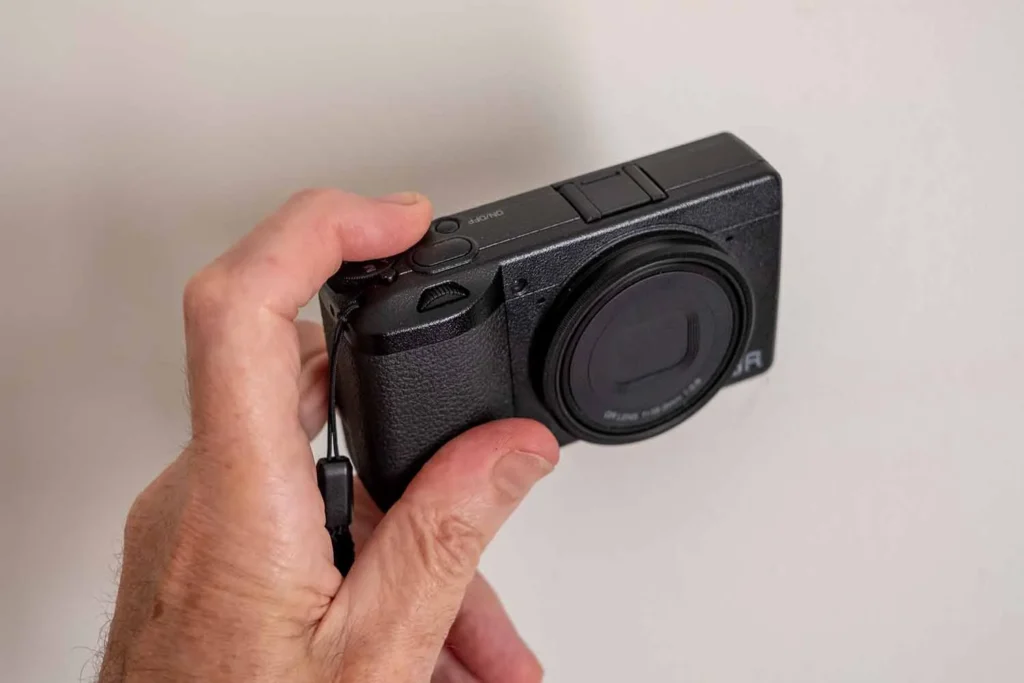
The Ricoh GRIII has IBIS, and I can shoot at 1/10th of a second and get sharp images. And it is tiny.
Weight
Mirrorless cameras weigh less than the equivalent dSLRs. It is true, but not by as big a margin as you might expect from removing the mirror box.
Twenty years ago I stopped taking my Nikon D700 around with me because it weighed 1095g. It was a great camera but not something I would casually put on my shoulder, My Canon R6 weighs 680g – a 415g difference, nearly a pound weight saved.
The Bottom Line
What do I want from a camera?
- A big, clear, detailed EVF that I feel I can almost walk around in, with clear numbers in the display
- To be able to see clearly and exactly where I am focusing
- Good autofocus
- A shutter button that is like the proverbial glass rod, that breaks cleanly
- Rock-solid image stabilisation
Can I get all of those from a dSLR? Not so much. The one strength of a dSLR is the optical viewfinder. For example, my Canon R6 mirrorless camera it sometimes tells me in no uncertain terms that it is an EVF. It gets the exposure completely wrong for a moment when I move to a new subject. The EVF washes out and I have to stop half-pressing on the shutter, and recompose to get the EVF to correct itself.
That’s when the camera reminds me that I am looking at an EVF, and I don’t like the experience.
Apart from that, and for image stabilisation alone, mirrorless wins.