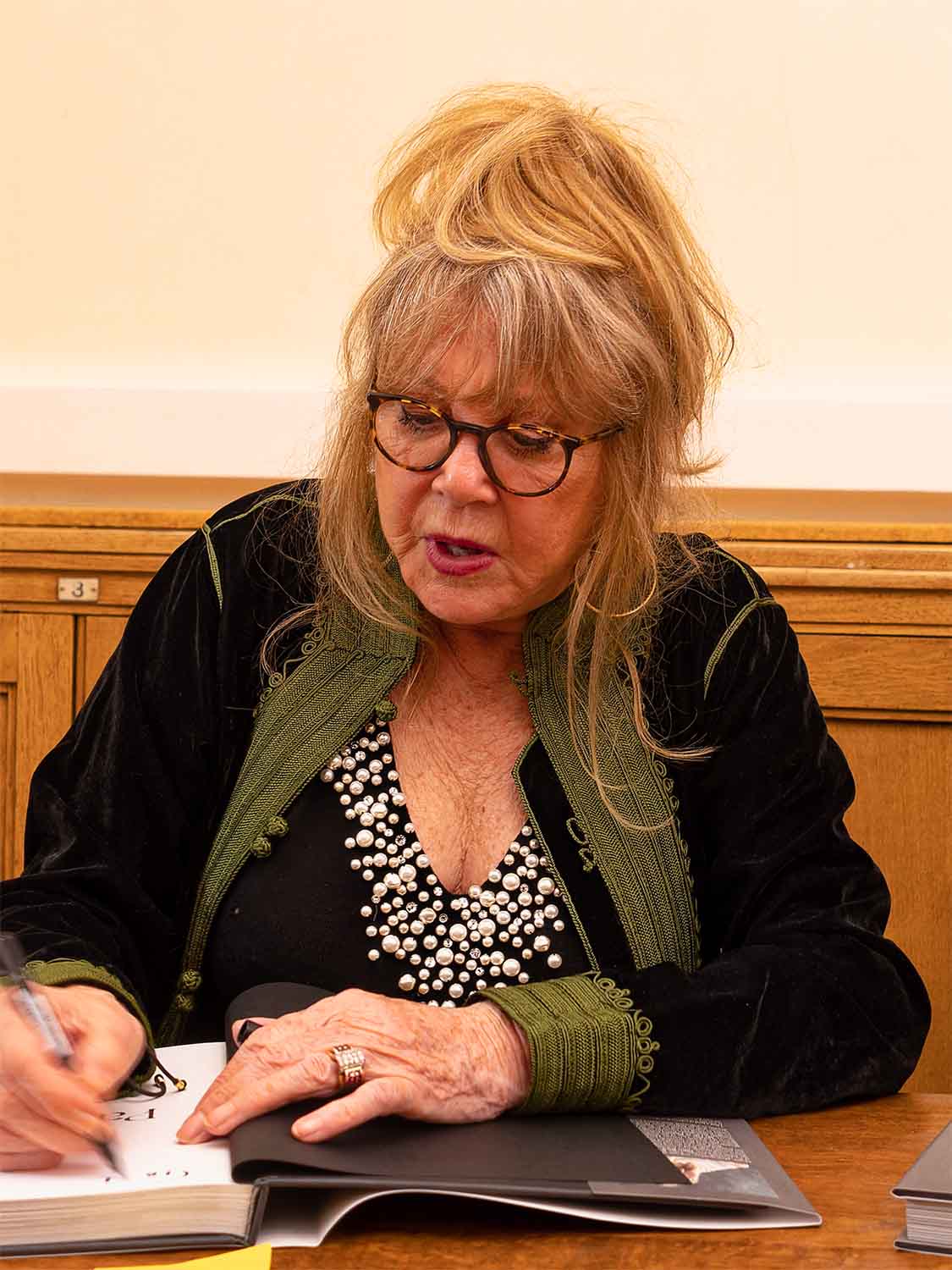
Pattie Boyd at a book signing in Cambridge 21 April 2023. Photographed with a Ricoh GR III at ISO 800, 1./10 second at f2.8. I held the camera at mid chest height and looked down estimating when the subject was properly in the frame. This is a crop, my wife is stood just to Pattie’s side.
After signing these two books (Tamara bought one for a close friend) Pattie got into an involved conversation with my wife. They got on like a house on fire, and I photographed the conversation on my iPhone.
Pattie Boyd on Wikipedia
Patricia Anne Boyd (born 17 March 1944) is an English model and photographer. She was one of the leading international models during the 1960s and, with Jean Shrimpton, epitomised the British female look of the era. Boyd married George Harrison in 1966, experiencing the height of the Beatles’ popularity and sharing in their embrace of Indian spirituality. She divorced Harrison in 1977 and married Harrison’s friend Eric Clapton in 1979; they divorced in 1989. Boyd inspired Harrison’s songs ” Need You”, “If I Needed Someone”, “Something” and “For You Blue”, and Clapton’s songs “Layla”, “Bell Bottom Blues” and “Wonderful Tonight”.
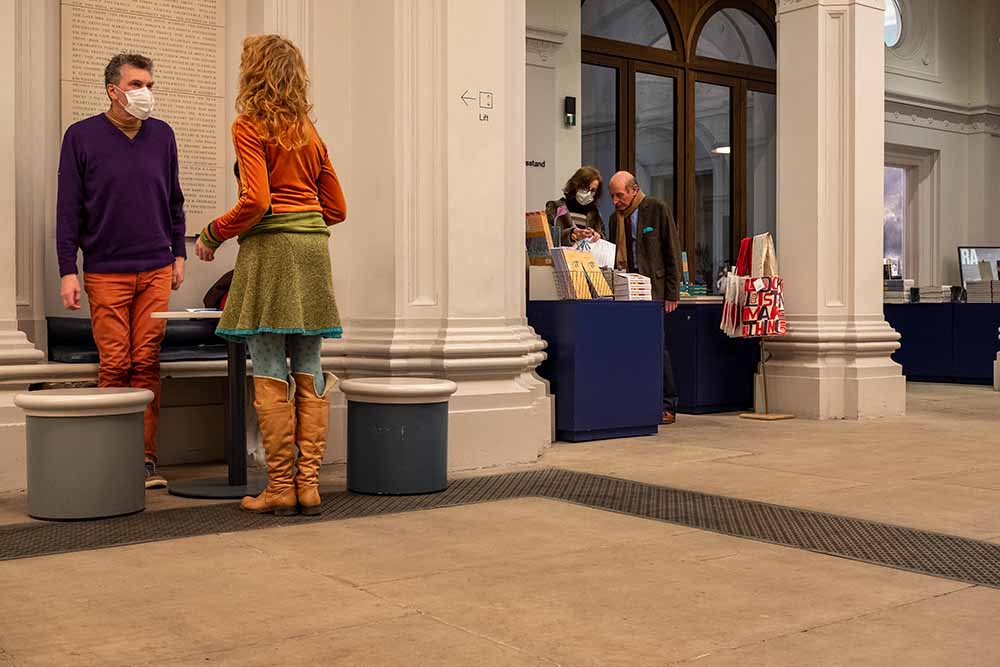
I was just watching a YouTube video by Stephen Leslie in which he says that fateful sentence. I guess it is true, and even a vase of flowers or a bowl of fruit can be forensically examined for life in former times. So then I was looking at some of my own photos, and came across this that I took on the 27th January this year (with an X-E3 with 27mm f2.8 lens). I took it because of some consonance between the colours of the clothing of the man and the woman. And also simply because it was colourful. And because of the way the two of them are standing.
And who knew that just this eleven months later that masks would be gone for the most part, and that the masks here would become a social document.
George Monbiot writes for the Guardian and has written a book Regenesis: Feeding the World without Devouring the Planet.
He was interviewed by Bee Wilson, a food critic, a week ago or so at the Cambridge Literary Festival. Someone had a sense of humour in pairing the two of them. Monbiot’s message for the evening was that the planet is drowning in animals raised for food. Animal meat and milk feeds a tiny proportion of the world’s people compared to the land devoted to raising feed to feed the animals.
Moving to a plant-based diet will not help because the land use is increased to the detriment of the planet’s need for a wild ecosystem.
What will help, he says, is to bring science into the picture and culture high protein flour. Culturing food has a small footprint and does not require an outside source of biomass to keep it going.
He gave some figures on the makeup of the animal biomass of the planet, but the talk moved too quickly for me to retain it all. So I looked up the study published in Proceedings of the National Academy of Sciences, and now I have a bigger picture.
Total Biomass
Plants make up about 80 percent of of the Earth’s biomass; bacteria make up about 15 percent; and the remaining 5 percent is animal biomass.
Animal Biomass
Of the animal biomass, things that crawl (arthropods) make up 50 percent, and fish, humans, livestock, and wild animals and birds make up the other 50 percent.
Mammal and Bird Biomass
So now we are drilling down to humans, and to mammals and birds that are kept in captivity and raised for food, and to wild animals.
Of the total biomass of mammals and birds, those farmed for food makes up around 60 percent, and wild mammals only 4 percent. The other 36 percent is us – humans.
Perspective
So, 5 percent of all biomass is animal, and of that fish, humans, livestock, and wild animals and birds account for 50 percent. And of that 2.5 percent of all biomass, 60%, – or 1.5% of all biomass – is animals and birds farmed for food. Yet to support their continuance as a food source, we take up huge swathes of land to make feed to feed to those animals, to feed a tiny proportion of humans.
Monbiot’s argument is that we in the developed nations are living irresponsibly at the top of the biosphere, causing overshoot.
Overshoot – the inability of a system to maintain itself because it devours the materials that are required for its maintenance.
How very individually we think and feel, and how differently we are required to think and feel if we are not to speed on and overshoot the capacity of the planet to feed us.
Book Signing
Tamara bought Monbiot’s book about six months ago, and she brought it to the event.
The book is ‘Regenesis: Feeding the World without Devouring the Planet‘
I asked George Monbiot if it was OK to photograph him, and I took these shots as my wife Tamara talked to him about Compassion In World Farming, a charity that she supports. Monbiot had heard of the organisation and he too is in favour of it.
Animals raised for food worldwide are treated abominably. There is an argument for saying that if animals were treated compassionately, part of the problem outlined by Monbiot would be alleviated because demand could not be met, And that could be a good start to weaning off meat.
Camera Notes
I took these photos with a Ricoh GR III held at about waist height. I could see the LCD, so it wasn’t too difficult to get the framing. I shot in Aperture Priority at ISO 2000, 1/40th second at f2.8
Ah, the spectacles of the woman standing were so interesting. And the hair and the denim jacket. And the closeness of the relationship of the three of them. They talked without polite niceties, like families do. At least like close families who can actually talk to one another do. And they were French, so a whole different approach to life.
My main focus has been to find out what is lightweight., so this is not a full list of all Nikon, Fuji, and Ricoh camera weights and lens weights.
That said, I have included one heavy camera because I ownd a Nikon D500, and that weighs 860g, I have included it to show where is sits in the continuum of weight. Basically, it weighs the same as two D3500s or three-and-one-third times the weight of a Ricoh GR III, or two-and-a-half times the weight of a Fuji X-E3.
I have also listed lightweight lenses. As you will see, the X-E3 plus a 27mm lens is 30g lighter than an X100s, but the form factor might make the X100s more pleasant to carry because the lens doesn’t stick out. If you like to protect your cameras like I do, then putting the X100s in a Fuji leather case is a good option but it bumps the weight up to 605g.
But then, after I bought the X-E3 I realised I was going to have to carry a Billingham case because otherwise I would have to carry the camera slung over my shoulder. And I really do not like carrying a camera without any protection. When I am using it, yes. But otherwise I like to protect it somehow, and the cases for the older model X100 series were perfect because they were all in one piece. That is not the case with the X100V and the X100VI. For some reason Fuji decided to make a case such that when you opened it, you were left with the top piece in your hand. And what are you supposed to do with that while you are shooting?
That said, if there is one brand that I observe stands up to rough treatment best, it is Nikon cameras. They wear well.
Z 28mm f2.8 SE lens 155g Z 16-50mm (3.5-6.3) 135g Z MC 105mm f/2.8 VR S 630g F mount 35mm f1.8 200g F-mount AF-S DX 18-55mm f/3.5-5.6G VR II 195g F-mount AF-S VR Micro-Nikkor 105mm f/2.8G IF-ED. 750g
Full Frame Mirrorless Cameras
Canon EOS R6 680g Canon EOS R6 II 670g Canon EOS R8 461g Canon RF 50mm f1.8 STM lens 160g Canon RF 35mm f/1.8 Macro IS STM 300g Nikon Z5 675g Nikon Z6 II 705g Sony A7 III 650g Panasonic Lumix S5 II 740g